
Measuring & Verifying Savings in Performance Contracts: Making Energy Savings Real
Mark Stetz, PE, PMVE CMVP
Energy Savings Performance Contracts (ESPCs or EPCs) improve facility operation and reduce utility costs by implementing energy conservation measures (ECMs). The project is paid from the energy, water, and O&M cost-savings. To protect the customer, savings are guaranteed.
However, a guarantee has little value if not supported by facts. Measurement & verification (M&V) is the process of validating the energy and financial performance of the project to assure the customer that promises are being fulfilled. Energy and cost savings are reported relative to what would have happened had the project not been implemented. Common M&V procedures and guidance are defined in the International Performance Measurement and Verification Protocol (IPMVP®) published by the Efficiency Valuation Organization (https://evo-world.org/). Using globally-recognized best practices assure the customer that Iconergy’s reported savings are reliable and trustworthy.
Measuring & Verifying Savings
A common misconception is that we measure savings. However, one can’t measure what doesn’t exist! Energy use in different scenarios is measured with savings being attributed to the energy not used.
A common method of reporting savings is what the IPMVP defines as Avoided Use (or Avoided Cost). Savings are not the difference between what was used or spent during the baseline year and what was used or spent during the reporting period, as too many variables will have changed. To make a fair comparison, the baseline is adjusted to the reporting period conditions and then compared. The process can be expressed as a very simple formula:
Avoided Energy Use = Adjusted Baseline Energy − Reporting-Period Energy
The process of defining the Adjusted Baseline Energy can be simple to very complex. In rare cases, adjustments to the Reporting Period Energy may also be required. Avoided Use savings can fluctuate each reporting period due to changes in weather, occupancy, or other factors which can introduce a small amount of risk if the guarantee is not met due to atypical conditions.
To reduce variability, savings can be based on a defined set of conditions and is what the IPMVP refers to as Normalized Savings. In this scenario, savings can be based on a specific number of operating hours, customers served, or on typical weather conditions. This too can be expressed as a simple formula:
Normalized Energy Savings = Adjusted Baseline Energy – Adjusted Reporting-Period Energy
By fixing the conditions, savings remain constant each year regardless of actual operating hours, customers served, or actual weather conditions.
Select the Appropriate Method
The IPMVP defines four general approaches to verifying savings which are based on where the measurement boundary is located. Options A and B are retrofit isolation methods where the measurement “box” is drawn around the affected equipment (red borders). Options C and D are whole facility methods where the measurement boundary is the entire facility (green borders).
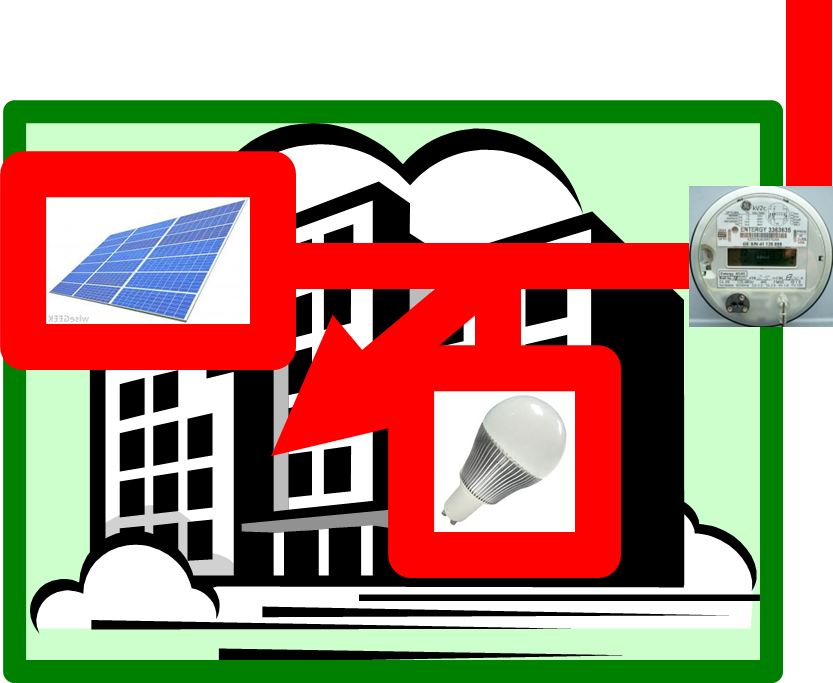
Selecting the measurement boundary depends on the type of ECM, the number of variables to be included (or excluded) in the evaluation, the magnitude of the expected savings, and the M&V budget available.
When evaluating simple systems (i.e. lighting, solar), Options A and B are often used to eliminate interference from energy used in other parts of the facility.
Where an entire facility contains many interacting or difficult-to-measure ECMs (i.e. controls retro-commissioning, windows), Options C and D may be more effective. A whole facility approach may eliminate the need to evaluate individual ECMs with Options A or B as they will be captured.
Performance Contracts often use different M&V approaches for each ECM. The following table describes each of the IPMVP Options.
| IPMVP Option | What you measure | When it fits best | Typical ESPC examples |
|---|---|---|---|
| A: Retrofit Isolation – Key Parameter Measurement | Measure key (performance) parameters; estimate non-key (usage) parameters. | When performance is stable and estimation risk is acceptable. | Lighting power measured, hours estimated; small controls upgrades |
| B: Retrofit Isolation – All Parameter Measurement | Continuously measure all parameters and/or energy use. | When loads/ hours vary and higher certainty is needed. | Variable-speed drives, HVAC equipment where runtime and loads vary. |
| C: Whole Facility | Use whole-building (or sub-facility) meter data with normalization/ adjustments. | When savings are large enough to stand out from facility “noise”. | Multi-ECM bundles; campus buildings with significant savings. |
| D: Calibrated Simulation | Use a calibrated energy model when direct baseline data isn’t available. | When a historic baseline doesn’t exist or is irrelevant. | New construction, major expansion, campus buildings with no meters, missing utility history. |
How M&V Fits Into a Performance Contract
A good Performance Contract project includes M&V in the project development, installation, and annual reporting phases. Attempting to develop an M&V process after the project is complete is fraught with difficulty and is to be avoided.
1) Develop a robust baseline during project development
A robust baseline starts with complete utility, equipment, and weather data. For an investment Grade Audit, the customer provides one to three years of utility data and access to their facility. Iconergy assesses equipment performance by installing short-term measurement devices or obtaining data from the building control system. Government- or university-operated stations provide weather data. This information defines the current energy use, cost, and operating conditions.
2) Verify installation and operation first
IPMVP explicitly recognizes operational verification as a set of activities to ensure the ECM is installed, commissioned, and performing as intended. This process may include visual inspection, short-term measurements, or installing permanent meters. These steps are a necessary part of any good M&V process.
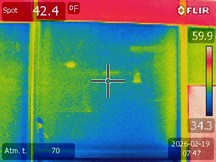
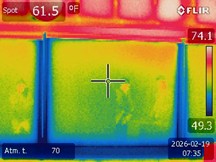
In the images below, thermal measurements of an old window showed an interior temperature of 42 F while the new window had an interior temperature of 62 F when the outdoor air temperature was 25 F. While it is difficult to verify savings from these images alone, they show the new windows have a much higher thermal resistance than the old ones.
3) Measure, verify, and report — every year
During each performance period, Iconergy will follow the M&V plan that is included in the IGA. Actions include reviewing utility bills, making site inspections and visual observations, pulling trend data from the control system, and taking short-term measurements.
That information is used to make any routine (and non-routine if needed) adjustments to the baseline energy use, compute the energy and cost savings, and document any changes to operating conditions observed. In the event an ECM does not meet its expected performance, we investigate the cause of the deficiency. If it is an equipment performance related issue, we will address the problem by repairing, replacing, or altering the ECM so that it performs as intended. If the issue is an atypical condition over which Iconergy has no control (atypical weather conditions, reduced operating hours, etc.), we will document the issue and describe the consequences of the condition.
That process is repeated as long as contractually required (three years for Colorado projects, finance term for federal projects). The goal is to demonstrate that the aggregate savings of all ECMs exceed the guaranteed value for each year where M&V reporting is required. In the exceptionally rare event of an annual savings shortfall, Iconergy will work to repair or improve the non-performing ECMs or make additional improvements to increase savings. As a last resort, Iconergy would cover the shortfall to make the customer whole – something we work diligently to avoid!
The real goal: allocate risk & responsibilities
Think of M&V as an insurance policy that protects both parties by:
- Defining and allocating project risks.
- Describing baseline and annual activities.
- Minimizes and quantifies uncertainties.
- Identifies performance or O&M issues early.
- Protects both parties from utility rate volatility.
- Sets expected outcomes and guaranteed values.
- Provides dispute resolution language.
A robust M&V plan and effort is critical to the success of all EPCs by assuring the customer that the promised performance has been and continues to be delivered each year.
Closing thought
IPMVP Options A–D are valuable tools in a larger toolkit. Selecting the correct Options for a project depends on many factors including the choice of measurement boundary, data availability, ECM risks, allowable uncertainty, and of course budget.
Iconergy partners with our customers to provide an M&V plan and activities acceptable to all parties. Our goal is to provide a project and process that stakeholders can trust every year.

Author Bio: Mark Stetz, P.E. has over three decades of energy-efficiency, utility program demand-side management, and measurement & verification experience. He is currently a Senior Energy Engineer at Iconergy, where he helps develop performance-contracting projects for both large and small customers and is responsible for verifying their savings.
Prior experience includes supporting multiple utility DSM programs, federal (FEMP) performance contracts, and contributing to multiple M&V guidelines and protocols. He also is an Efficiency Valuation Organization, certified M&V instructor. Mr. Stetz has a BS ChemE from Drexel University and an MSME from Colorado State University.
Related Posts

Higher education has no shortage of competing funding requests. Whether it’s innovative research due to expanding STEM Programs…

In a world where the importance of energy efficiency and sustainability has never been more apparent, educating the…