
Office Building Case Study: Improving EUI for Energy Performance Compliance
How retro-commissioning and targeted improvements reduced Energy Use Intensity by 19%
By Erik Jeannette | Iconergy
Why this case study matters
It is common to assume that swapping out equipment will immediately lower a building’s Energy Use Intensity (EUI). In practice, meaningful EUI improvement usually requires a sequence of steps: diagnosing how systems operate day-to-day, implementing operational fixes, verifying results, and then capturing a full 12 months of post-improvement utility data for compliance reporting. For many office buildings, that timeline is 6-8 months (or longer) from kickoff to measurable, defensible results.
This office-building case study shows what it takes to reduce EUI in a way that supports compliance pathways such as Energize Denver and the Colorado Building Performance Standards (BPS), while also reducing utility costs and improving occupant comfort.
Typical EUI-reduction timeline
- Weeks 1-6: Investigation, data collection, and retro-commissioning (RCx) assessment
- Months 2-6: Implement operational changes and facility improvements; verify performance
- Months 6-12: Build a post-improvement 12-month utility dataset for compliance documentation
Project overview: Office Building A
In fall 2023, Iconergy was contracted to perform a retro-commissioning (RCx) study for an office building (referred to here as “Office Building A”). The goal was to assess energy use, identify practical improvement measures, and create a clear path toward meeting upcoming energy performance requirements.
The team delivered a combined set of Energy Conservation Measures (ECMs) and Facility Improvement Measures (FIMs), plus a longer-term capital improvement roadmap aligned with expected equipment end-of-life.
Results at a glance
| Verified EUI reduction | 16.9 kBtu/ft² (19% of annual energy use) |
| Estimated annual utility cost savings | $31,213 |
| Simple payback (estimated) | 1.5 years |
| Measures developed | 11 ECMs and 11 FIMs |
| Compliance impact | Surpasses near-term targets and nearly meets final performance compliance |
Note: “Office Building A” is anonymized; results will vary by building type, systems, operations, and baseline performance.
How performance was measured
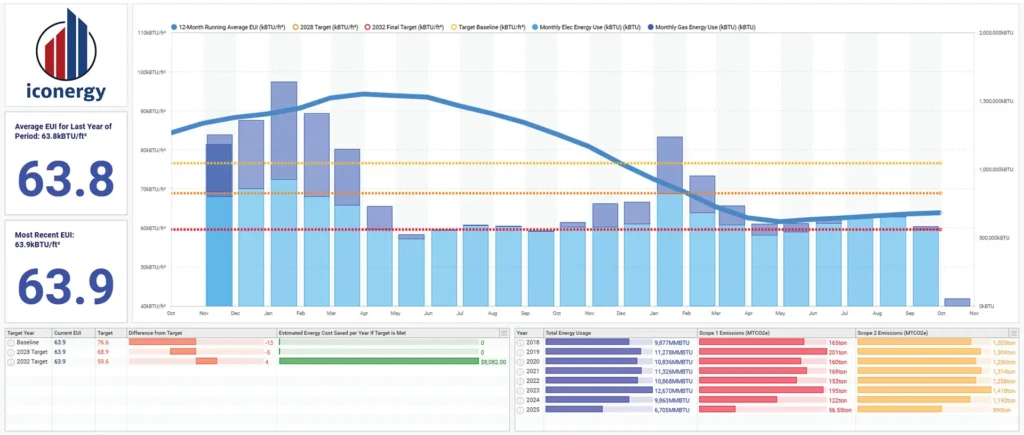
To document baseline performance and track improvement, the project used Energy Star Portfolio Manager® data and integrated those calculated values into Iconergy’s monitoring-based commissioning platform. This workflow supports building-wide analytics across multiple data sources, making it easier to visualize energy use, emissions, trend data, and compliance progress over time.
Key chart elements used in the project’s reporting included:
- 12-month running average EUI (kBtu/ft²)
- Monthly gas energy use (kBtu)
- Monthly electricity energy use (kBtu)
- Reference lines for baseline and future performance targets (for example, 2028 and 2032 goals)
Tracking results over an extended period also helps reduce the risk of “EUI creep” – the gradual rise in energy use that can occur when schedules, setpoints, or controls drift over time.
Implemented efficiency measures
The RCx process produced 11 ECMs and 11 FIMs. The measures focused on optimizing existing systems first, then correcting performance issues that create persistent waste.
Examples of Energy Conservation Measures (ECMs)
- Refined lighting schedules to better match occupancy and business hours
- Resolved air-handling unit control issues to prevent simultaneous heating and cooling
- Optimized chiller operation to improve part-load efficiency
Examples of Facility Improvement Measures (FIMs)
- Monitored and repaired terminal units to restore proper zone control
- Replaced faulty or drifting sensors to improve control accuracy
- Corrected airflow through the variable air volume (VAV) system to align with design intent
Together, these measures were estimated to deliver $31,213 in annual utility cost savings with an estimated 1.5-year simple payback, alongside the 16.9 kBtu/ft² EUI reduction.
Capital improvement roadmap (equipment replacement)
Building mechanical and environmental systems typically have expected lifespans of roughly 15 to 30 years, depending on maintenance, runtime, and component quality. For Office Building A, Iconergy developed a capital plan timed to major equipment replacement around 2030.
Combined anticipated EUI reduction from the capital plan: 14.1 kBtu/ft².
Important: Savings from these future replacements are not included in the results above. They are presented to show how early planning supports final compliance by 2032.
Compliance depends on a 12-month EUI average
Most energy performance programs evaluate compliance using a full year of utility data. That matters because seasonal loads can be very different – for example, energy use in June is often higher than in January. A lower annual EUI average is achieved by reducing monthly EUI early enough that the improvements are reflected across the entire reporting year.
For building owners and managers, the practical takeaway is simple:
- Start improvements before the calendar year you plan to submit.
- Allow 6+ months to define scope, implement measures, and verify results.
- Plan for the additional 12 months needed to build a defensible post-improvement dataset.
Key takeaways
- Replacing equipment can be part of the solution, but operational optimization and control fixes often deliver faster, lower-cost EUI reduction.
- Monitoring-based commissioning helps prove results and sustain performance over time.
- A staged plan (operational measures now, capital replacements at end-of-life) reduces risk and supports long-range compliance targets.
- Starting early is the best way to avoid fines, meet deadlines, and capture utility savings sooner.
FAQ: EUI reduction and compliance
EUI measures a building’s energy consumption normalized by floor area, commonly expressed as kBtu per square foot per year (kBtu/ft²). Lower EUI generally indicates better energy performance.
Timelines vary, but meaningful, documentable improvement often takes 6-8 months for assessment and implementation, plus 12 months of post-improvement utility data for compliance reporting.
RCx is a systematic process that evaluates how existing building systems operate, identifies inefficiencies, and implements and verifies improvements – often without major equipment replacement.
A 12-month average smooths seasonal variation and aligns with how many programs evaluate compliance. It provides a clearer before-and-after picture than single-month comparisons.
EUI creep is the gradual increase in energy use caused by schedule drift, setpoint changes, or control issues. Ongoing monitoring, trending, and periodic recommissioning help sustain savings.
Ready to reduce your building’s EUI?
If you have an upcoming energy performance deadline, starting sooner gives you more options and better outcomes. Iconergy helps owners and facility teams prioritize measures, implement improvements, and document results for compliance.
Contact Iconergy to discuss retro-commissioning, monitoring-based commissioning, and compliance planning for your building.

Author Bio: Erik has managed projects as well as teams for commissioning, monitoring-based commissioning, retro-commissioning, energy audits, and HVAC DDC Design projects since 1997. His work includes a wide array of energy engineering and research projects from many sectors of the industry including the development and implementation of energy saving sequences of operation; design, installation, programming and commissioning HVAC energy management systems and utility monitoring systems; and extensive mechanical and electrical equipment knowledge. At Iconergy, Erik’s role is to lead energy engineering efforts, manage and develop projects, and provide overall quality control of the engineering work produced. Erik’s extensive technical expertise coupled with his drive for customer satisfaction has led to a long history of project success.
Article originally published by the Colorado Real Estate Journal (01/02/2026)
Related Posts

FOR IMMEDIATE RELEASE October 14, 2025 CEG Solutions and Iconergy Announce Strategic Merger to Expand Energy Services Capabilities…

A $300M Energy-Efficiency Transformation The Wyoming State Capital Complex, located in Cheyenne, WY, underwent a transformation with the…

